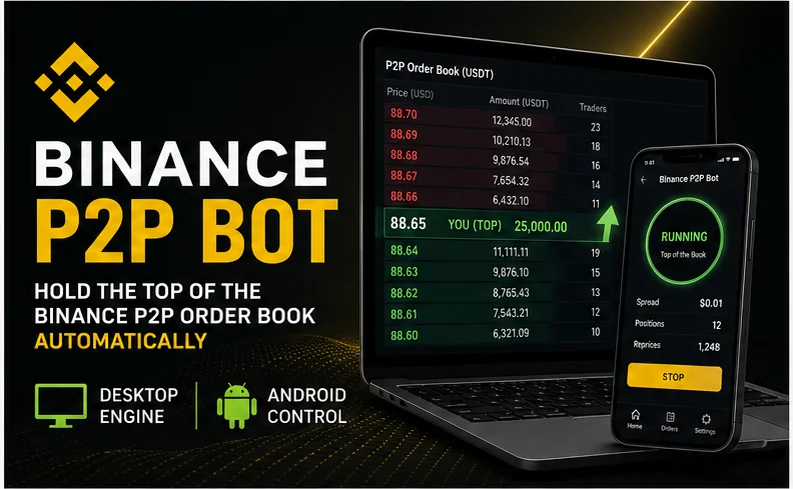
Free Binance P2P bot from GitHub — what you actually get
Search "binance p2p bot" on GitHub and you'll find repositories. Some are real attempts, some are homework projects, some are bait. Before you clone one and paste your API keys into it, you should understand what the free options can actually do. The answer is different on Binance and on Bybit, and the biggest risk is not the code quality.
The API reality: Binance and Bybit are not the same
Bybit has an official P2P API. It's documented in Bybit's own help center. The P2P Open API lets Verified and Block advertisers view ads and orders, and, with write permissions, create and edit ads. If you're a Bybit advertiser, an automated tool builds on supported ground.
Binance publishes no public P2P ad-management API. Its documented merchant tools live in the web Merchant Portal: quick edit, floating and fixed pricing, buyer filters, auto-reply, scheduled offline hours. Developer-forum threads say merchants can request private P2P API documentation from customer service, but that is community talk, not published docs. In practice this means any Binance P2P automation, free or paid, works against an interface Binance does not publicly document. A tool that is not actively maintained breaks the day something changes. With an abandoned GitHub script, nobody is coming to fix it.
What free scripts typically don't do
The core loop is simple: read the list, and if someone beat you, set your price under theirs. That is ten lines of code, which is why free scripts exist. It is also why they lose money. The decisions a simple script does not make are the actual job:
- Who counts as competition. A free script chases every ad. That includes a regular user with a tiny limit posting an unrealistic price, or a merchant demanding extra KYC your buyers can't pass. You end up pricing against ads that will never take your volume.
- Where the floor is. A script that follows the best price with no hard floor will follow a price war all the way down. The merchant who wins a price war is the one whose tool refuses to cross a line.
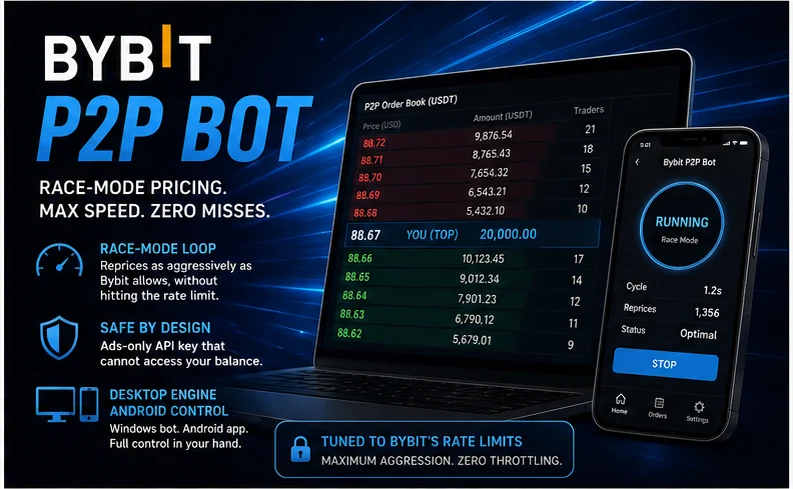
- Rate limits. Bybit slows down or rejects ads that update too often. A dumb timer loop gets your ad hidden exactly when the market moves fastest. A real tool separates how often it checks from how often it spends a price change.
- Your own ads. Binance requires your same-pair ads to sit at least 0.5% apart. Bybit requires 1%. Run two ads with a simple script and they block each other.
- The empty-market case. No valid competitor right now? A free script either freezes or does something strange with your price. You want a fallback price you chose in advance.
None of this is advanced. It is just work that has to be done correctly on every cycle, forever. Most free repositories stopped being maintained the month after they were pushed.
The risk that should actually decide this
Forget features for a second. The real question with any bot, free or paid, is this: what can the API key you give it do?
A pricing bot needs to read the market and edit your ads. Nothing else. On Binance that is a key with only the Reading permission. On Bybit, only the Fiat Trading (Ads) permission. A key like that physically cannot withdraw, trade, or transfer your money, even if it leaks.
Now look at what a random script asks for. If the setup instructions tell you to enable trading or withdrawal permissions, or to enter your login credentials instead of an API key, stop. You are no longer evaluating a bot. You are deciding whether a stranger on the internet gets your balance. Scam "P2P bots" that harvest keys are a known pattern, and a merchant's account is a fat target, because it holds working capital by definition.
This is the standard we think every tool should be held to, including ours: TickBots runs on read-only / ads-only keys, stores them on your PC only, and publishes SHA-256 checksums for every download.
So when is free the right answer?
Honestly: if you are technical, you trade small, you enjoy maintaining your own tools, and you are on Bybit, where the official API gives you a stable base, then a self-built bot is a fine hobby project. You will learn a lot.
If you are a merchant whose income depends on holding position all day on Binance and Bybit, the math changes. The price of a maintained tool is a one-time cost. The price of a free script is your time, plus your position every time it breaks without warning, plus, in the worst case, the API key you gave it. What separates a real tool from a script is not secret knowledge. It is the boring decisions made correctly on every cycle: filters, floors, rate limits, own-ad gaps. Plus someone whose job is to fix it when the exchange changes something.
Free is a real option. It is just rarely the cheap one.