How to get more orders as a Binance P2P merchant
Order flow on a P2P market is not a mystery. Buyers open the list, see a stack of ads, and pick from the top of it. They filter by whether they trust the ad and whether your payment methods match theirs. Every order you don't get went to someone who beat you on one of those. Here is the playbook, factor by factor, with what the exchanges themselves document.
1. Position: the factor that pays for everything else
Both exchanges rank the normal list by price first. Binance says it plainly: a more competitive price gets more customers, and completion rate doesn't affect your ad's position. Bybit's published sorting rules put price fourth in priority. But the three slots above it are special placements and penalties. So within the normal list, price decides, and advertiser status and completion rate only break ties.
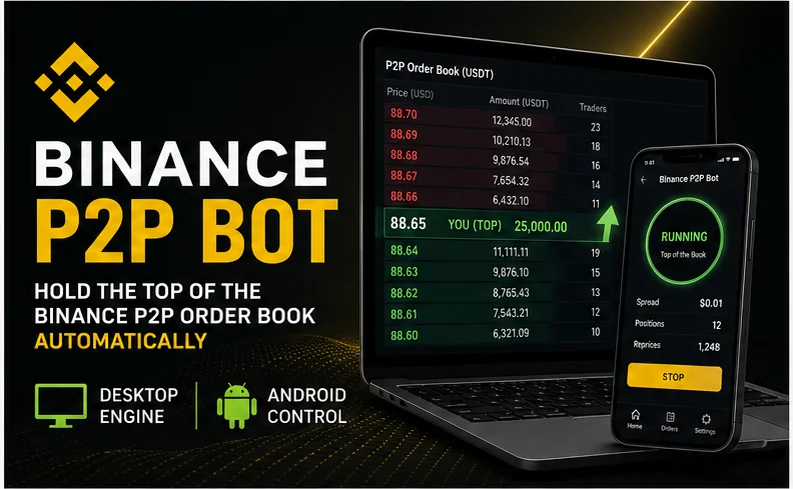
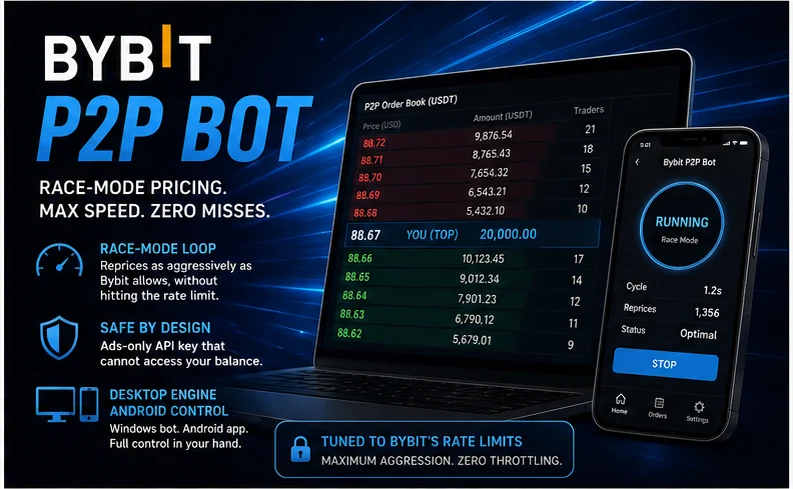
This means the most valuable thing a merchant can do is hold the best price above your floor all day, not check it five times a day. Every minute between a competitor's better price and your correction is order flow you gave away. We wrote a full piece on why ads sink and how repricing works. The short version: holding position all day is exactly the job an auto-repricing bot does.
2. Completion rate and response: the trust filters
Completion rate won't lift your position, but buyers read it before clicking, and the platforms lock features behind it. Binance requires ordinary users to hold 80%+ completion just to post ads. Bybit's advertiser tiers require 80–90% depending on level. Practical rules that protect it:
- Don't post ads you can't serve. An out-of-stock sell ad that forces cancellations damages your completion rate.
- Watch your open disputes. On Bybit, more than 30 open order appeals hides all your ads automatically. Too many incomplete orders hides one side of your book.
- Reply fast. When two prices are similar, buyers pick the merchant who answers in seconds. Prepared first responses help. So does the Android-app notification the moment a new order lands.
3. Merchant status: apply as soon as you qualify
Status is a tie-breaker in ranking and a big trust factor (the yellow tick exists for a reason). What is documented:
- Binance verified merchant: advanced KYC, a security deposit held in USDT, and an application reviewed within 15 working days. There is a required deposit per fiat zone to keep advertising, and volume tiers earn 20–50% fee discounts. Verified merchants can also run more ads per pair.
- Bybit advertiser levels: a documented ladder from General (Beginner/Regular/Veteran) to Verified (Bronze/Silver/Gold) and Block. The published requirements start at 5 completed orders and 80% completion for Beginner (sell ads only, small caps). They scale to 50 orders and 90% for Veteran, with a 200 USDT security deposit. Higher tiers unlock both sides of the book, bigger ad sizes and more pairs. And at equal price, higher status ranks above lower.
If you already qualify for the next tier but have not applied, you are giving up better placement and higher limits.
4. Payment methods: the invisible filter
Buyers filter the list by how they can pay. Every popular local method you don't accept removes you from that buyer's list completely, no matter your price. Binance P2P supports hundreds of payment methods across 100+ currencies. In each market, two or three of them dominate. Add the dominant ones you can really serve, and no more. Every method you list is a method you must verify payments on, and unfamiliar payment rails are where payment scams live. Reversible methods deserve special caution on the sell side.
5. Ad structure: run both sides and more than one ad
- Use both sides. Buy flow and sell flow balance each other's inventory. One-sided merchants run out of cash or coins at exactly the wrong time.
- Run parallel ads at different sizes where your tier allows it. Binance allows up to 3 per pair and side, 4 for higher tiers. A small-limit ad catches retail buyers. A big-limit ad catches the large buyers. Remember the platforms force a minimum price gap between your own ads (0.5% on Binance, 1% on Bybit), so plan them instead of letting them collide.
- Keep remarks clean. No external links or off-platform contact. That is a documented violation on Binance and a fast way to lose the ad or the badge.
The loop that compounds
These factors feed each other. Better position brings more orders. More orders build volume and completion rate. That earns a higher tier, which brings more ads, better tie-breaks and lower fees. Lower fees mean better economics at the same price, so you can afford a slightly better price. And a better price improves your position again. Merchants who keep this loop running move far ahead of merchants who only check the app a few times a day.
The entry point of the loop is position, and position is a speed game. Reprice faster than the merchants around you: every second on Binance, race-mode within the limits on Bybit. The rest of the playbook gets easier, because the orders keep coming while you work on it.