Why your Binance P2P ad is not on top — and how to fix it
You post a good ad. Ten minutes later it's fifth on the list and your phone is quiet. Before you blame your completion rate or start re-posting the ad, you should know what actually decides position. Both exchanges have said or published more about this than most merchants realize. Here is what their own documentation says, and what you can do about each piece.
What Binance itself says about ranking
Binance doesn't publish a full algorithm, but its own merchant guide, "Get Your Binance P2P Ads to Appear Among Top Ad Search Results", is direct about three things:
- Price is the lever. "Those who set a more competitive price have a higher chance of attracting more customers." Buyers see the best price first. The list is, at its core, a price ranking.
- Completion rate does not move your position. In Binance's own words, "completion rate doesn't affect your ad position." It affects whether buyers trust your ad, and whether you're allowed to post at all. But it will not lift a worse price above a better one.
- Re-posting doesn't help. "Frequently changing your ad will not help boost its position." There is no freshness bonus. Position follows price. If your price didn't improve, deleting and re-creating the ad does nothing.
So when your ad sits fifth, it's almost never a mystery. Four people have a better price than you, or hold the same price with a stronger status.
Two paid exceptions exist, and you should know about them. Featured Ads put one ad "at the uppermost section" of the marketplace. That slot is invite-only, one ad per trading pair per fiat zone. And since late 2025, Ad Bidding lets verified merchants bid for a promoted slot, "displayed at the top... throughout the promotion period." If the very first listing looks unbeatable no matter what you do, it may simply be paid placement. Everything below it is the organic price race. That's where you compete.
What Bybit publishes (more detail than Binance)
Bybit actually publishes its sorting rules, and the order tells you a lot:
- A "Top Picks for New Users" slot (verified advertisers with small limits and a better price, shown only to first-time P2P users).
- A "Special Recommendation" row: the top five verified advertisers with the best prices.
- A penalty tier: suspicious or misleading ads pinned to the bottom.
- Then price. Highest first on the sell side, lowest first on the buy side.
- At equal price, advertiser status breaks the tie (Block > Verified > General).
- Then 30-day completion rate.
Read that carefully. Status and completion rate only matter as tie-breakers at the same price. Price ranks first, on both platforms.
The mistakes that quietly keep you down
Your own ads fight each other. Binance requires your own ads on the same pair and side to differ in price, at least 0.5% apart in most markets (0.1% in some). Bybit requires a 1% gap. If you run two ads and one "won't update," the other one is probably blocking it.
You're not eligible for the position you think you deserve. On Binance, ordinary users can only post ads after 30 days on the platform, 20 completed P2P orders, an 80%+ completion rate and 10 different trading partners. On Bybit, advertiser tiers limit how many ads and how much volume you can run. Status won't rank you above a better price, but low status caps what you can post at all.
Your ad is hidden and you don't know it. Bybit auto-hides ads when appeals or incomplete orders pile up. For example, more than 30 open order appeals hides all your ads. It also delists ads after 30 days without a login. If your ad vanished rather than dropped, check for these.
The fix is boring: hold the best price above your floor, all day
Once the paid slots and eligibility rules are accounted for, the game is one sentence long: be one step better than the best real competitor, all day, without crossing your own floor.
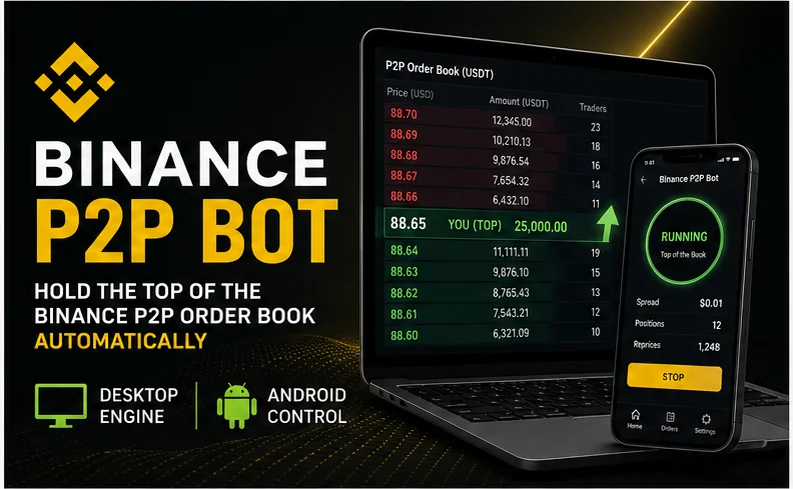
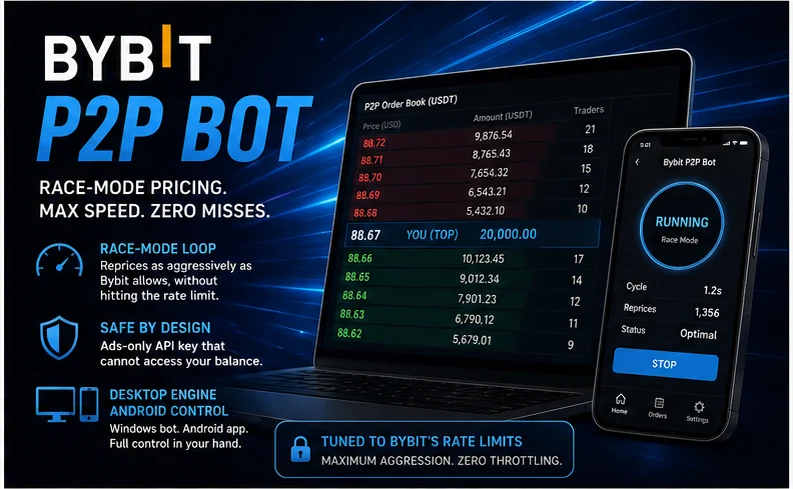
Doing that by hand is the actual problem. The market moves every few seconds. Every time a competitor beats your price, your ad drops, and the orders go to them until you notice. Watching the list all day is a full-time job. And it is exactly the part that software does better than people. An auto-repricing tool checks the list all the time. It moves your price one step past the best competitor you actually want to compete with, not every unrealistic ad with a tiny limit. And it refuses to cross the floor you set. On Binance it can do this as fast as every second. On Bybit it works in race mode inside Bybit's posting rules.
Binance's advice to set a more competitive price is correct. The only question is whether you'll be doing it manually at 3 a.m., or whether something does it for you.