Binance P2P vs Bybit P2P — the merchant's comparison, 2026
If you sell USDT for a living, the "Binance or Bybit?" question is not about which app looks nicer. It is about where your capital turns faster and which rules you will be operating under all day. The two platforms differ more than most merchants expect, and both actually document those differences. Here is the comparison that matters, built from their own pages, checked in July 2026.
The short answer first: Binance P2P is the bigger market, with more coins, more fiats and paid top slots. Bybit P2P is the more transparent and more automation-friendly platform, with published sorting rules and an official ads API. Serious merchants increasingly run both, which is exactly why splitting volume across the two is normal now.
Coins and markets
- Binance P2P trades USDT, USDC, BTC, ETH, BNB and FDUSD (plus a few promotional tokens), across 118 fiat currencies and hundreds of payment methods. If your market is small or unusual, Binance is more likely to have it.
- Bybit P2P trades USDT, USDC, BTC and ETH (no BNB) across roughly 75 fiat currencies. 73 had live ads in July 2026. Fewer markets, but the big P2P corridors are all there: PKR, INR, VES, BRL, NGN and the CIS currencies.
For pure market size, Binance wins. For most merchants' actual corridor, both have it.
How ads rank — the biggest practical difference
Both lists are, at their core, price rankings. But the two platforms are opposites in how much they tell you:
- Binance publishes only guidance: a better price gets more customers, completion rate does not affect ad position, and re-posting an ad does nothing. What it does sell is placement: Featured Ads (invite-only, one per pair per fiat zone) and Ad Bidding, where verified merchants bid for the top slot. On Binance, the very first listing may simply be paid.
- Bybit publishes its full sorting order: special placements for new users, a "top 5 verified advertisers by price" row, a penalty tier for suspicious ads. Then price. Then advertiser status as a tie-breaker (Block > Verified > General). Then completion rate. You can even see your ad's live rank on the Merchant Dashboard.
The takeaway for merchants: on both platforms, the organic game is hold the best price above your floor all day. On Binance, accept that the #1 slot may be bought. On Bybit, status matters at equal prices, so climbing the advertiser ladder has direct ranking value.
Merchant programs and deposits
- Binance verified merchant: advanced KYC, a security deposit held in USDT (required per fiat zone to keep advertising), and an application reviewed within 15 working days. Volume tiers earn 20–50% fee discounts and up to 4 ads per pair and side. Regular users can post ads too, but only after 30 days on the platform, 20 completed orders, 80% completion and 10 different trading partners.
- Bybit advertiser ladder: the published requirements are unusually concrete. Entry starts at 5 completed orders and 80% completion (sell ads only, small caps) and scales to 50 orders and 90% for Veteran, with a 200 USDT security deposit. Verified (Bronze/Silver/Gold) and Block tiers unlock both sides, bigger ads and more pairs. Block advertisers take orders from 10,000 up to 300,000 USDT.
Bybit's entry bar is lower, and every requirement is a published number. Binance's program is heavier, but it comes with the bigger market behind it.
The rules that bite in daily operation
- Your own ads must keep a price gap: at least 0.5% between your same-pair ads on Binance (0.1% in some markets), 1% on Bybit. Run two ads without managing this and they block each other.
- Bybit auto-hides ads when problems pile up. More than 30 open order appeals hides everything you have. Too many incomplete orders hides one side. 30 days without logging in delists your ads.
- Update speed is a real limit on Bybit. In practice, ads that change price too often get slowed down or rejected. A repricing setup has to separate how often it checks the market from how often it spends a price change. Binance allows far more. Our own engine reprices there as often as every second.
- Remarks rules: both platforms forbid external links and off-platform contact in ad remarks. On Binance it is a documented violation that can cost the ad or the badge.
Automation — the clearest win for Bybit
- Bybit has an official P2P Open API for Verified and Block advertisers: view ads and orders, and with write permissions, create and edit ads. Automation there runs on supported, documented ground.
- Binance publishes no public P2P ad-management API. Its documented tools live in the web Merchant Portal: quick edit, floating and fixed pricing, filters, auto-reply, scheduled hours. Developer-forum threads mention private API docs available to merchants through support, but that is community talk, not documentation.
If you plan to automate, and at merchant scale you eventually will, this difference matters. On Bybit, any well-built tool stands on the official API. On Binance, tool quality and maintenance matter even more, because the integration surface is not public. It is also why free scripts break more often on Binance.
Where you can actually use them (July 2026)
- EEA/EU: neither. Binance failed to secure a MiCA license and cut EU services around 1 July 2026, P2P included. Bybit has a MiCA license, but its EU platform launched without P2P, while EEA access to the global platform ended. Details in our country-by-country legal guide.
- India: both, registered with FIU-IND (Binance since Aug 2024, Bybit since Feb 2025), both with INR P2P.
- Pakistan: both operate PKR P2P. Neither is fully licensed yet under the new PVARA regime (Binance holds a first-stage NOC from December 2025).
- Latin America: both (BRL, VES, PEN, MXN and more on each).
The scorecard
| Binance P2P | Bybit P2P | |
|---|---|---|
| Coins | 6 core | 4 |
| Fiats | ~118 | ~75 |
| Ranking | Guidance only, paid top slots | Full rules published |
| Entry bar | Heavier: KYC + USDT deposit | Lower, published numbers |
| Own-ads gap | ≥0.5% | 1% |
| Repricing | Every second possible | Throttled, needs pacing |
| Ads API | No | Yes |
| EEA | No | No |
So which one?
If you're starting out: Bybit. Lower entry requirements, published rules, and the official API means your tools won't fight the platform. If you're chasing maximum volume and market coverage: Binance. More coins, more fiats, more buyers, at the price of heavier requirements and a paid top slot above you. If you're running serious capital: both, because the spreads and the flow differ by corridor and by hour, and two books balance each other.
That last option is why the TickBots bundle exists: one app that reprices on both. Every second on Binance, and race-mode inside the limits on Bybit. Running two exchanges shouldn't mean watching two screens.
Platform rules verified against the linked documentation on 9 July 2026. Exchanges change their rules — check the links before relying on a number.
Related bots
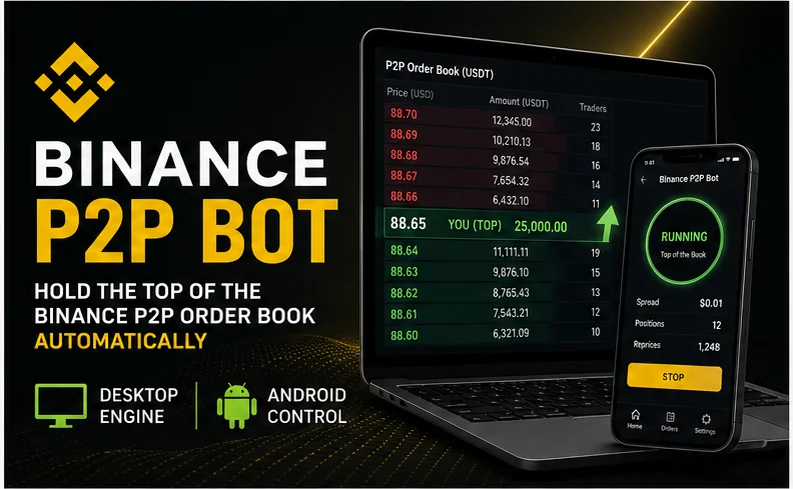
Binance P2P Bot
$500Keeps your Binance P2P ad at the top of the list, automatically.
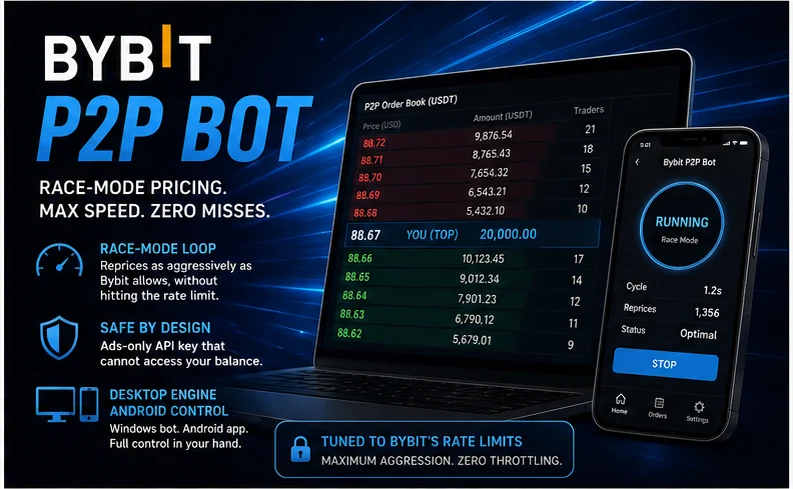
Bybit P2P Bot
$300Prices your Bybit P2P ads fast and stays inside Bybit's limits.

Binance + Bybit P2P Bundle
$700Get Binance and Bybit in one app, for less.