Which crypto exchanges have P2P trading in 2026?
Ask which exchanges have P2P and you'll get lists that include platforms with no P2P product, platforms that quietly left your country two years ago, and fee claims from 2023. So we checked. Every claim below comes from the exchanges' own help centers, announcements and fee pages, or from primary reporting, all verified on 9 July 2026. Eight major exchanges run a real P2P marketplace (buyer and seller ads with escrow). Here is the honest map.
The short table
| Exchange | Coins | Fiats | Fees | API | EEA |
|---|---|---|---|---|---|
| Binance | 6 core | ~118 | Maker % + flat taker | No | No |
| Bybit | 4 | ~75 | Zero, few exceptions | Yes | No |
| OKX | 4+ | ~110 | Zero | No | No P2P |
| KuCoin | 5 | ~48 | Zero | No | No P2P |
| Bitget | USDT+ | ~60 | Zero* | Yes | No |
| MEXC | 4 | ~60 | Zero | No | No |
| HTX | 3 | ~60 | Zero | No | No |
| Gate | 3 | ~69 | Zero | Yes | Unclear |
Fees: Bitget charges NGN makers 0.1%; Bybit has maker fees in NGN/RUB/GHS and both-side fees in AZN; Binance charges makers 0.1–0.35% by market plus a flat 0.06–0.08 USDT taker fee on USDT pairs. Fiat numbers are live-market counts (exchange APIs / p2p.army, 9 July 2026).
No P2P marketplace at all: Coinbase, Kraken, Upbit, despite what some lists say. Coinbase's 2025 "P2P" launch is a USDC payments feature, not a marketplace. Kraken's "Krak" app is the same category. Upbit has no P2P feature.
The two giants
Binance P2P is the biggest marketplace: six core cryptos (plus a few promotional tokens) across 118 fiat currencies with hundreds of payment methods. One thing most "zero-fee" lists get wrong: Binance P2P is not free anymore. Makers pay per-market fees in dozens of fiat markets: 0.20% in markets like MXN, TRY and ARS, 0.15% for PKR and INR, and 0.25% for PEN and COP since April 2026. Since 2024, Binance has also charged a flat taker fee on USDT pairs: 0.05 USDT per order, raised to 0.06–0.08 USDT across 95 fiat markets from September 2025. It also sells placement, through invite-only Featured Ads and Ad Bidding.
Bybit P2P is the second pillar: four cryptos, roughly 75 fiat currencies (73 with live ads in July 2026), and zero fees in most markets, with maker fees in NGN, RUB and GHS and both-side fees in AZN. It publishes its sorting rules and offers an official P2P Open API for advertisers. We compared the two in detail here.
The challengers, one by one
OKX still runs an active P2P marketplace, with regional exits that matter. It left Nigeria entirely in August 2024 and India in April 2024, and removed RUB back in 2023. Where it operates (about 110 fiat currencies by live count: Pakistan, Southeast Asia, Latin America, Venezuela, East Africa), it competes hard: zero platform fees, and since March 2026 it even added SOL, DOGE and PEPE to the PKR market. Its merchant program has three tiers. Lite is automatic with KYC, and Diamond requires a deposit and monthly review. Since late 2025 it sells featured ad slots by bidding, the Binance playbook. No public merchant API.
KuCoin runs a zero-fee P2P marketplace across roughly 48 active fiat markets, and it is one of the few FIU-registered exchanges in India with INR/UPI P2P. Its Nigerian naira P2P has been paused since May 2024 with no confirmed return. The merchant ladder tops out at "Fox King" status: a 5,000 USDT deposit, 200+ orders and a 90%+ success rate. KuCoin sometimes waives deposits to grow new markets (it did for VES, MAD and AED). No public P2P API.
Bitget may be the most interesting challenger for merchants. It runs a real marketplace across roughly 60 live fiat markets (47+ officially listed), and it is strong in exactly the corridors others left. It courts Nigerian merchants where OKX and KuCoin exited, though NGN is its one non-free market: makers pay 0.1% there since February 2026. It is also one of only three exchanges with a documented, public P2P merchant API, together with Bybit and Gate. Merchant deposits are calculated by the system per currency.
MEXC is the unstable one. It suspended most of its fiat P2P pairs in 2023, then re-expanded hard from September 2025, adding NGN, ETB and PKR and then Latin America. It reaches roughly 60 live fiat markets today, backed by a long-term merchant incentive program aimed at South Asia, Africa and the CIS. Zero fees, a 200 USDT minimum merchant deposit, no API. Two warnings: MEXC suspended its India services in February 2026 pending FIU registration, and 2025 saw widely reported waves of risk-control account freezes. That is a real concern for a merchant holding working capital there.
HTX (ex-Huobi) runs a fee-free P2P across roughly 60 fiats with a 500 USDT verified-advertiser deposit. Its strength is the CIS: active RUB trading, including, per market trackers, payment rails through sanctioned Russian banks. That is a compliance risk a professional merchant should weigh, not ignore. A strange detail: HTX's own terms list Venezuela as restricted, yet a small live VES market trades on its P2P anyway. Treat access there as fragile. It also holds a Pakistan PVARA no-objection certificate from December 2025, the same round as Binance. It has no MiCA license, so the fact that it still loads in Europe means "unauthorized", not "available".
Gate (gate.com since the 2025 rebrand) is the quiet achiever: an active marketplace with zero fees, including for makers, which it openly uses to attract merchants. It also has a documented P2P Open API and a Malta MiCA license (October 2025). The caution: India, Pakistan and Venezuela sit on its restricted list on paper, yet live INR, PKR and VES markets were trading on Gate P2P in July 2026. That gap between paper and practice deserves care. Whether P2P is offered under its licensed EU entity is also unverified.
Telegram Wallet deserves its own line. Its P2P Market still operates (maker-only fee, merchant status needs KYC plus a 50 USDT deposit) and it remains big in the CIS. But its restricted list was updated on 6 July 2026 to include Pakistan and Bangladesh, and Ethiopian birr trading was suspended in June 2026. The era of "Telegram P2P is huge in South Asia" is over.
The EEA hole
Here is the striking 2026 fact: the P2P marketplace as a product category has left the European Economic Area. Binance (no MiCA license) cut EU services including P2P. Bybit's licensed EU platform launched without P2P. OKX's EU entity lists spot trading and margin lending only. KuCoin's EU platform launched spot-only. Bitget is restricting the EEA while its application is pending. MEXC and HTX are unlicensed. Among P2P-native platforms, Paxful wound down trading in November 2025 and NoOnes blocks all MiCA countries since 1 July 2026. What remains for EEA users is the non-custodial fringe: HodlHodl, Bisq, RoboSats, and Peach on a reverse-solicitation basis only.
Worth saying clearly: this is a platform problem, not a ban on you. MiCA licenses service providers. Fully decentralised, no-intermediary services are outside its scope (Recital 22), and individuals trading their own crypto carry no MiCA obligations. Full country-by-country detail is in our legal guide.
What "zero fees" really means
Most of the eight charge no percentage fee on P2P trades. But the giants are no longer free. Binance charges makers in many markets plus a flat USDT taker fee. Bybit now charges makers in NGN, RUB and GHS, and both sides in AZN. Bitget charges NGN makers 0.1%. Two honest footnotes to every "zero". First, several platforms sell placement instead (Binance's Featured Ads and bidding, OKX's featured-slot auctions since late 2025): free trades, paid visibility. Second, the real cost of P2P is never the platform fee. It is the spread you can hold against competitors, which depends on your position in the list far more than on a 0.1% fee. That is the actual game, and it is why position is worth automating.
What this means if you're picking a platform
Liquidity is still overwhelmingly on Binance and Bybit in most corridors. The challengers matter most where the giants left (Nigeria: Bitget and MEXC), or as a second book beside your main one. Check three things before committing money anywhere: your fiat corridor's actual ad depth, the merchant deposit and tier rules, and whether the platform has ever frozen or exited your market on short notice. The history above is the track record.
And wherever you post ads, the daily job is identical on all eight: hold the best price all day without crossing your floor. TickBots automates exactly that on the two platforms where most of the volume lives: Binance and Bybit, or both in one app.
Everything above was verified against the linked sources on 9 July 2026. Exchanges change fees, rules and country lists without much notice — check the links before relying on a specific number.
Related bots
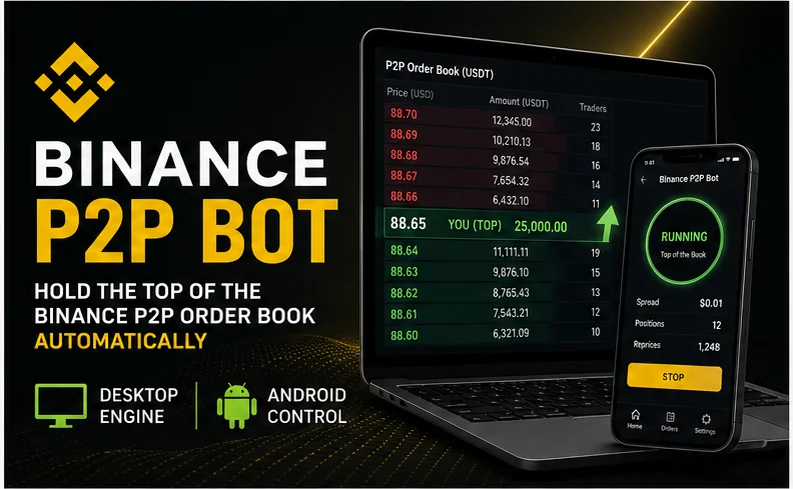
Binance P2P Bot
$500Keeps your Binance P2P ad at the top of the list, automatically.
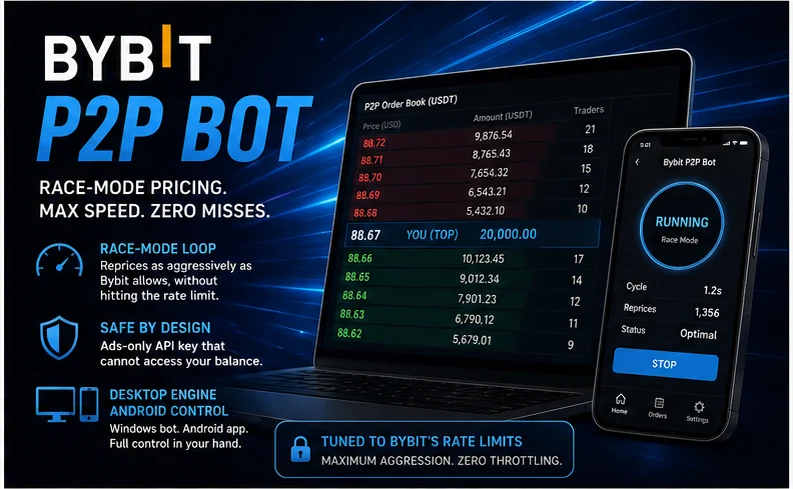
Bybit P2P Bot
$300Prices your Bybit P2P ads fast and stays inside Bybit's limits.
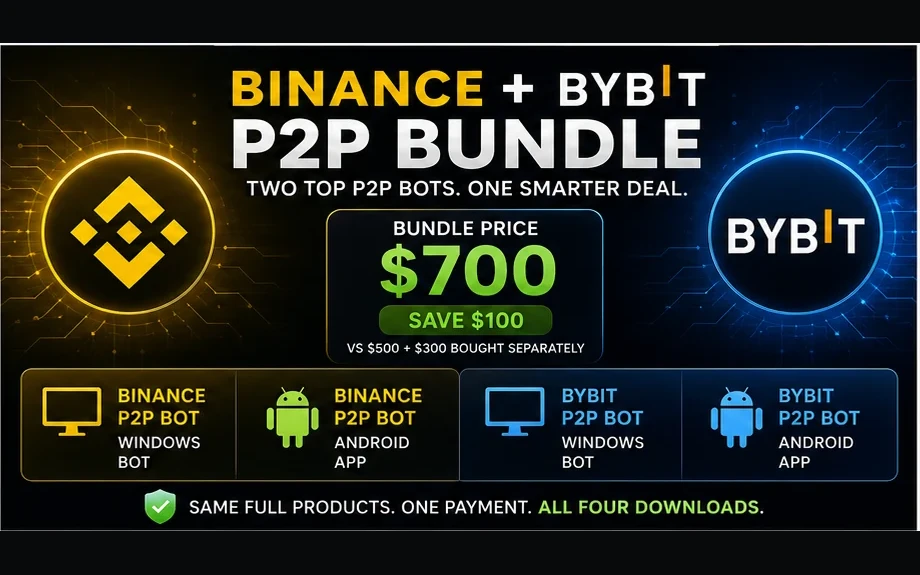
Binance + Bybit P2P Bundle
$700Get Binance and Bybit in one app, for less.