Fixed vs floating price on Binance P2P — which one to use
Every ad you post on Binance P2P or Bybit P2P has to pick one of two pricing modes, and picking wrong quietly costs money. The two modes answer different questions. A fixed price says "my ad costs exactly this." A floating price says "my ad costs the market reference times a percentage I choose." Here is what each actually does, and which coin belongs in which.
Fixed price: you set a number
A fixed-price ad shows the exact number you typed, say 4.05 PLN per USDT, until you (or your bot) change it. The platform never moves it for you.
That is both the strength and the weakness. The strength: total control. Your margin is whatever you set against your cost, and no market swing changes your ad without your decision. The weakness: nothing changes your ad without your decision. If the market moves while you sleep, your fixed price is either uncompetitive (you get no orders) or too generous (you get all the orders you don't want).
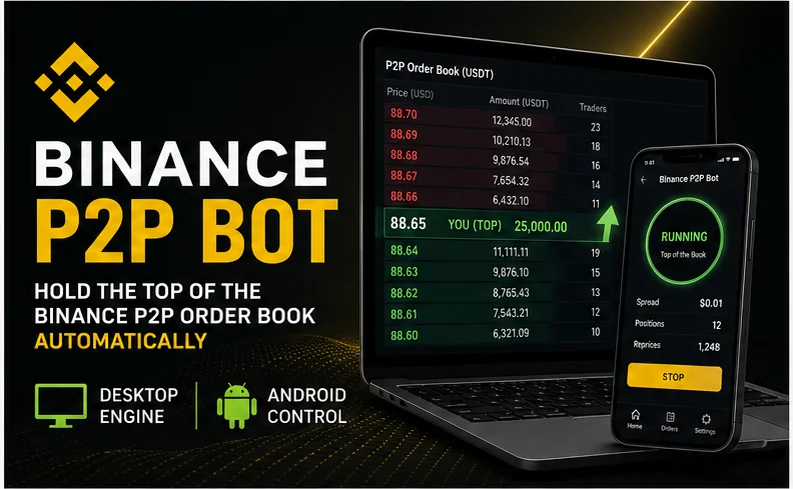
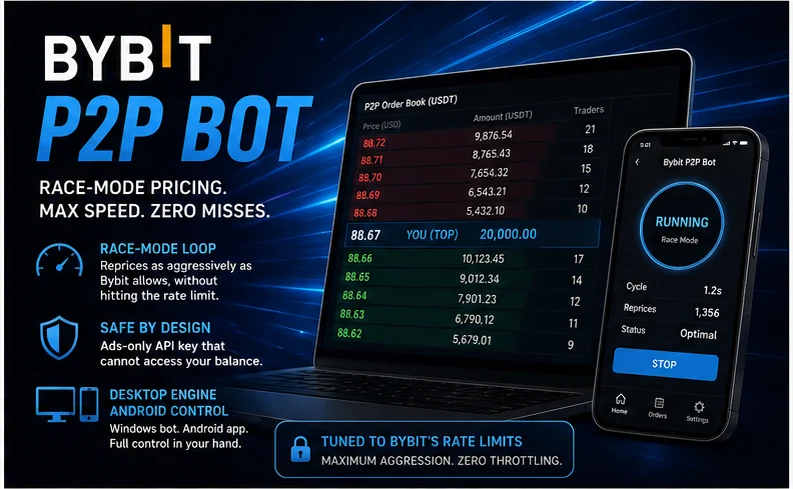
Where fixed belongs: stablecoins. USDT and USDC don't move against the dollar in any way that matters for your spread. What moves is the local fiat market around them: competitor prices, local demand, the street rate of your currency. Those move in steps you can follow. This is why stablecoin merchants live on fixed prices, and why repricing them is the core daily job. The price is a decision, and someone (or something) has to keep making it. On both exchanges, the ranked list is a price ranking, so the fixed number you hold is your position.
Floating price: you set a percentage
A floating-price ad is tied to the platform's market reference price for that coin, and you set a ratio. For example 101.5%, meaning your ad always sits 1.5% above the reference. When the reference moves, your ad price moves with it automatically. Bybit documents that its floating ad prices recalculate every few seconds against the reference. Binance works on the same principle.
Where floating belongs: coins that actually move, like BTC, ETH and BNB. If you sell BTC at a fixed fiat price and bitcoin jumps 3% in an hour, your ad is now 3% below the real market. Buyers will empty your inventory at your expense. A floating ad rides the move: the reference updates, your price follows, and your percentage margin survives the swing.
The floating trade-off is the mirror of the fixed one. You are protected against the coin's movement, but your ratio still competes against every other merchant's ratio. If competitors tighten from 101.5% to 101.2%, your ad slides down the list just like an old fixed price would. The number that needs watching is now the percentage instead of the price.
The rule of thumb, and when to break it
Stablecoins → fixed. Volatile coins → floating. That covers 90% of merchants, and it is how the TickBots apps are set up per coin. You choose the mode for each asset: fixed for USDT/USDC, floating for BTC/ETH/BNB (on Bybit: BTC/ETH, because it has no BNB market).
When to break it:
- Fixed on a volatile coin can make sense for very short windows. You see a specific opportunity, post it, and watch it. Never leave it alone.
- Floating on a stablecoin sounds clever but usually isn't. The reference for USDT barely moves, so floating gives you none of its protection, while making your real price slightly less predictable than just holding a number. Merchants who try it tend to go back.
What this means for repricing
Notice that neither mode removes the daily work. It only changes what you're adjusting. Fixed merchants adjust the price. Floating merchants adjust the ratio. In both cases the competitive question is the same: is my ad one step better than the best competitor I care about, right now? And in both cases the answer changes every time a competitor moves.
That is the part worth automating. A repricing bot works in whichever mode the coin is set to. It nudges a fixed PLN price on USDT, or a floating ratio on BTC, inside the floor and ceiling you set. The mode decides what the control knob is. Something still has to turn that knob all day, and it doesn't have to be you.