The Binance P2P glossary — 24 terms every merchant should know
P2P trading has its own language, and half the confusion new merchants face is really just terminology. Here are the 24 terms that come up every day on Binance P2P and Bybit P2P. They are defined the way merchants actually use them, not the way a lawyer would.
The marketplace
P2P (peer-to-peer) trading
Buying and selling crypto directly between users, with the exchange acting as referee instead of seller. You are not trading against Binance. You are trading with another person, and the platform holds the crypto in escrow until the money side of the deal is done.
C2C
Binance's internal name for the same thing (customer-to-customer). You will see it in API paths and old documentation. When a page says C2C, read P2P.
Merchant / advertiser
Anyone who posts ads instead of taking other people's offers. On Binance the levels run from regular ad posters to verified merchants. On Bybit the ladder is published openly, from entry-level advertisers up to Block merchants handling six-figure orders.
Ad (advertisement)
Your standing offer in the list: coin, fiat, price, limits, payment methods and terms. A merchant's whole business is keeping a handful of ads visible and priced right.
Order book / ad list
The ranked list buyers see for a given coin and fiat. It is sorted by price, best price first. That is why everything a repricing bot does revolves around this list.
Ad position
Where your ad sits in that list. Top positions take most of the orders. Page two takes almost none. Position is decided by price first, with platform rules as tie-breakers after it.
Corridor
A coin-fiat pair treated as a market of its own: USDT/PKR, USDT/VES, BTC/BRL. Liquidity, spreads and competition differ from corridor to corridor. That is why merchants talk about "my corridor" rather than "the P2P market."
Pricing
Price-to-beat
The price you need to beat to take the top spot. In practice, it is the best competitor's price after your filters (minimum order size, payment methods, named rivals) are applied. A manual merchant checks it all day. A bot recalculates it every second.
Fixed price ad
An ad priced at an exact number: "1 USDT = 4.05 PLN". It does not move unless you (or your bot) move it. This is the standard mode for stablecoins. The full trade-offs are in our fixed vs floating guide.
Floating price ad
An ad priced as a percentage of the platform's reference market price: "102.5% of index". It follows market moves automatically, but it says nothing about your competitors. You can float and still sit in fifth place.
Price step
The amount by which you beat a competitor's price. Repricing by the smallest step that wins the position, rather than jumping a whole cent, is most of the difference between a profitable ad and one that burns margin.
Floor / ceiling price
The hard limits you will not cross: the lowest you will sell for, the highest you will buy at. A well-set bot fights for position inside these bounds and goes quiet when the market leaves them. That safety rail is what makes automation safe to leave running.
Spread
The gap between your buy price and your sell price on the same coin. It is a merchant's gross margin. Volume × spread − fees is the whole business on one line.
Stablecoin premium
The extra amount local buyers pay above the dollar peg in restricted markets. USDT often trades several percent above "one dollar" in currencies losing value fast. It is why the same USDT earns different margins in different corridors.
Orders and safety
Escrow
The platform's hold on the seller's crypto while an order is open. The buyer does not have to trust the seller. Both trust the escrow. It releases only when the seller confirms the money arrived, or when an appeal is decided.
Release
The seller's confirmation that payment landed, which hands the escrowed crypto to the buyer. Releasing before the money is actually in your account is the most expensive beginner mistake in P2P.
Payment window
The countdown the buyer gets to pay and mark the order as paid. It is usually 15 to 45 minutes, depending on the ad. If it expires unpaid, the order cancels and the crypto returns from escrow.
Appeal
The platform's dispute process when one side says the other did not keep the deal. Evidence decides it: receipts, bank statements, chat history. Appeals are slow. Ads and filters that avoid risky traders are cheaper than winning disputes.
Completion rate
The percentage of a user's recent orders that finished successfully. Merchants filter out buyers with a low rate. Buyers read it as a trust signal. On Binance it does not affect ad position. That is a documented myth. But a falling rate can cost you the right to post ads.
Security deposit
Money a merchant locks with the platform to hold advertiser status. On Bybit the published entry deposit is 200 USDT. On Binance it is set per fiat zone. Breaking the rules can cost you the deposit. Leaving the program returns it.
KYC / AML
Identity checks and anti-money-laundering rules. For a working merchant this is not just paperwork. The documents the other trader verified with decide your odds in an appeal. And in the EEA, the MiCA rules now decide where P2P is even offered.
Automation
Read-only API key
An exchange API key whose permissions allow reading data but not trading, withdrawing or transferring. It is the security base of well-designed P2P automation. A bot holding a read-only key can watch the ad list and manage ad prices, but it can never touch your funds, even if the key leaks.
Repricing bot / P2P bot
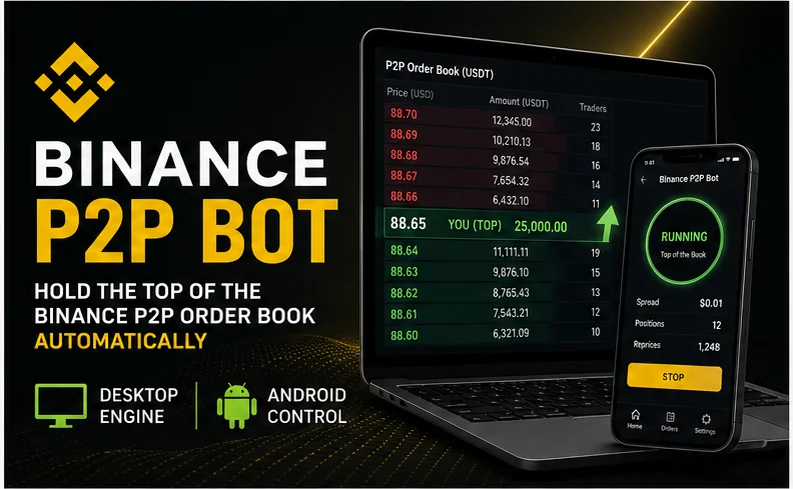
Software that watches the ad list and adjusts your ad prices automatically, within your floor, ceiling and filters. The whole idea in one line: the top of the list takes the orders, and a bot holds that spot without you watching a screen. Some bots run in a vendor's cloud and hold your API key there. TickBots runs on your own PC.
Rate limit
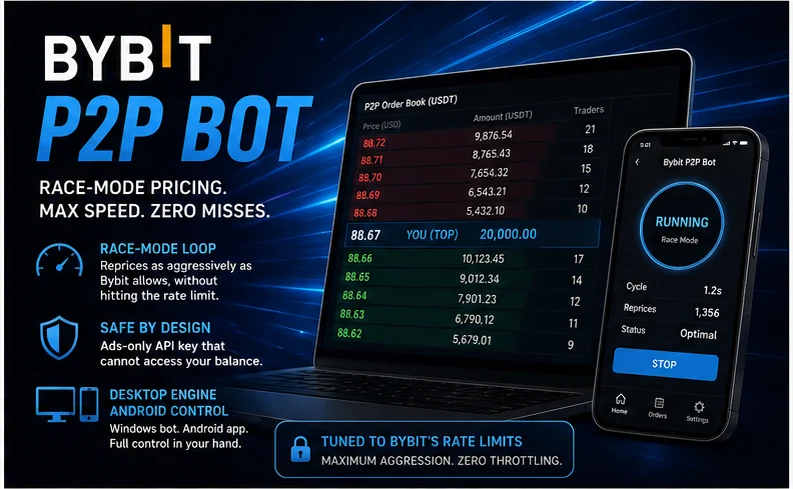
The cap an exchange puts on how often an API key can act: so many requests or price updates per time window. A good bot prices right up against the limit without crossing it. A crude one gets its key blocked for a while in the middle of a busy hour, which is worse than being slow.
That is the working language. If you are setting up automation for the first time, start with the read-only Binance API key guide, pick your pricing mode with the fixed vs floating guide, and see what the Binance P2P bot automates end to end.