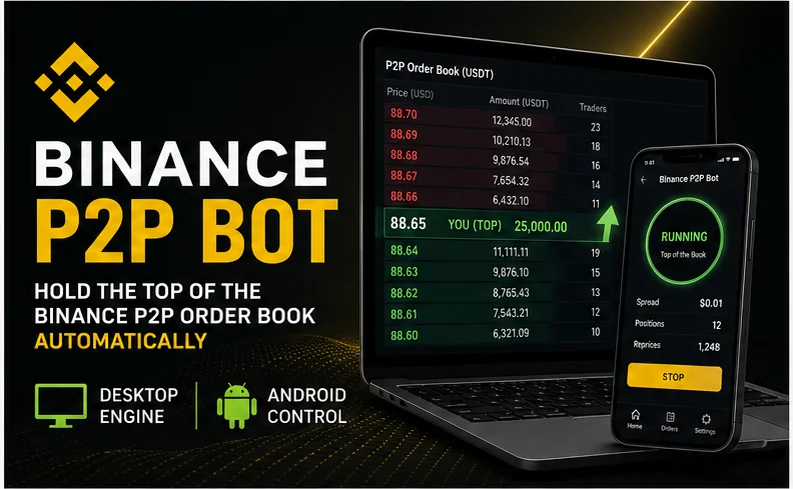
How a Binance P2P bot works — the loop, step by step
A Binance P2P bot sounds mysterious until you see the loop it runs. There is no AI magic and no secret access. There is one cycle, repeated as fast as every second. It does what you would do by hand if you could watch the ad list all day without blinking. Here is that cycle, end to end.
The repricing loop, step by step
-
Read the ad list. Through Binance's API, the bot pulls the current ad list for your coin and fiat: every competitor's price, limits and payment methods. It is the same list buyers see. The bot just fetches it by machine instead of refreshing the page.
-
Filter out the noise. Not every ad in the list is real competition. The bot drops the ones you told it to ignore: ads below your minimum order size, ads with payment methods you don't offer, KYC-locked ads a normal buyer can't take, and any rivals you excluded by name.
-
Find the price-to-beat. From what is left, it finds the best competing price. That is the number your ad has to beat to sit on top. This is the price-to-beat, and it changes every time any competitor moves.
-
Decide, inside your limits. If beating that price by one step stays inside your floor (selling) or ceiling (buying), the bot moves your ad exactly one step past the competitor. Never more than needed. If winning would mean crossing your limit, it does nothing and holds at the limit. That single rule is what stops a price war from eating your margin.
-
Update the ad. The bot sends the new price through the API. It times the updates to stay within Binance's rate limits, so the key never gets blocked in the middle of a busy hour.
-
Repeat. One second later, the loop runs again. A competitor who beats you at 14:03:07 is behind you again by 14:03:08. That is the whole value: steady repetition no human can match, not cleverness.
What the bot reads, and what it can touch
The loop above needs two permissions: read the market, and manage ad prices. It does not need trading, withdrawal or transfer rights. That is why a well-designed bot runs on a read-only API key. With that key, the worst any software can do is look at data and move your ad price inside the platform. Even if the software were malicious, even if the key leaked. It cannot sell your crypto, cannot withdraw, cannot touch balances.
That is the security test to apply to any P2P bot before it gets near your merchant account: what permissions does the key it asks for actually have? If a vendor asks for more than the loop needs, ask why.
The guardrails
Automation without limits is just a faster way to lose money. So every serious bot is built around the rules you set before it starts:
- Floor and ceiling. The prices it will never cross, whatever competitors do.
- Price step. How finely it beats a rival. The smallest step that wins keeps your margin as high as possible.
- Competitor filters. Who counts as competition and who gets ignored.
- A fallback price. Where your ad rests when there is no real competition to react to.
Set well, these turn the bot into what it should be: your pricing policy, carried out every second without getting tired. The bot never decides strategy. It carries out yours, all day, without getting bored or emotional.
Where the loop runs: your PC or their cloud
Every P2P bot runs this same loop somewhere. The difference between products is where:
- Cloud bots run it on the vendor's servers. Convenient, because there is nothing to install. But your API key lives on infrastructure you don't control, and you keep paying every month for as long as you trade.
- Local bots run it on your own machine. TickBots takes this route: a Windows engine runs the loop on your PC with your key stored locally, and an Android app lets you change limits, pause ads or check status from your pocket. One payment, and the second year costs nothing.
We compared both models, and the products on each side, in the Top 5 Binance P2P bots ranking.
What it looks like in a real day
You set your floor at breakfast: USDT sells no lower than your cost plus margin, step one hundredth, ignore the big KYC-locked merchant at position one. Then you do something else. Through the day, competitors test you. They beat you by a cent, get passed again within a second, and some give up. Others race down to their own floor and stop there. Your ad spends the day at or near the top, within your rules. Orders arrive. The only manual work left is releasing crypto when payments land, which is the one thing you should never hand over to automation without care.
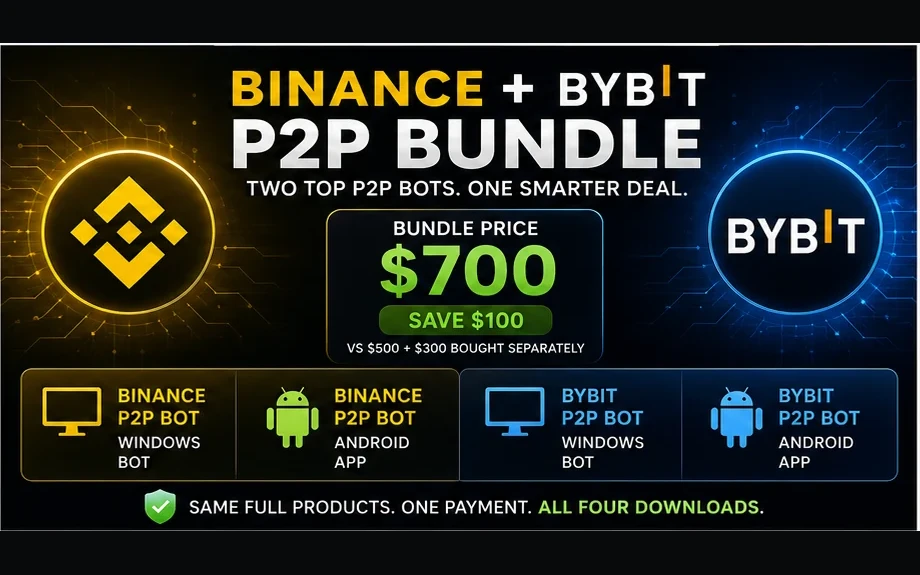
That is the whole machine. If the terms above are new to you, the P2P glossary defines each one. If you want to see the loop in a product, the Binance P2P bot page shows exactly what it automates. The bundle runs the same loop on Bybit too.